
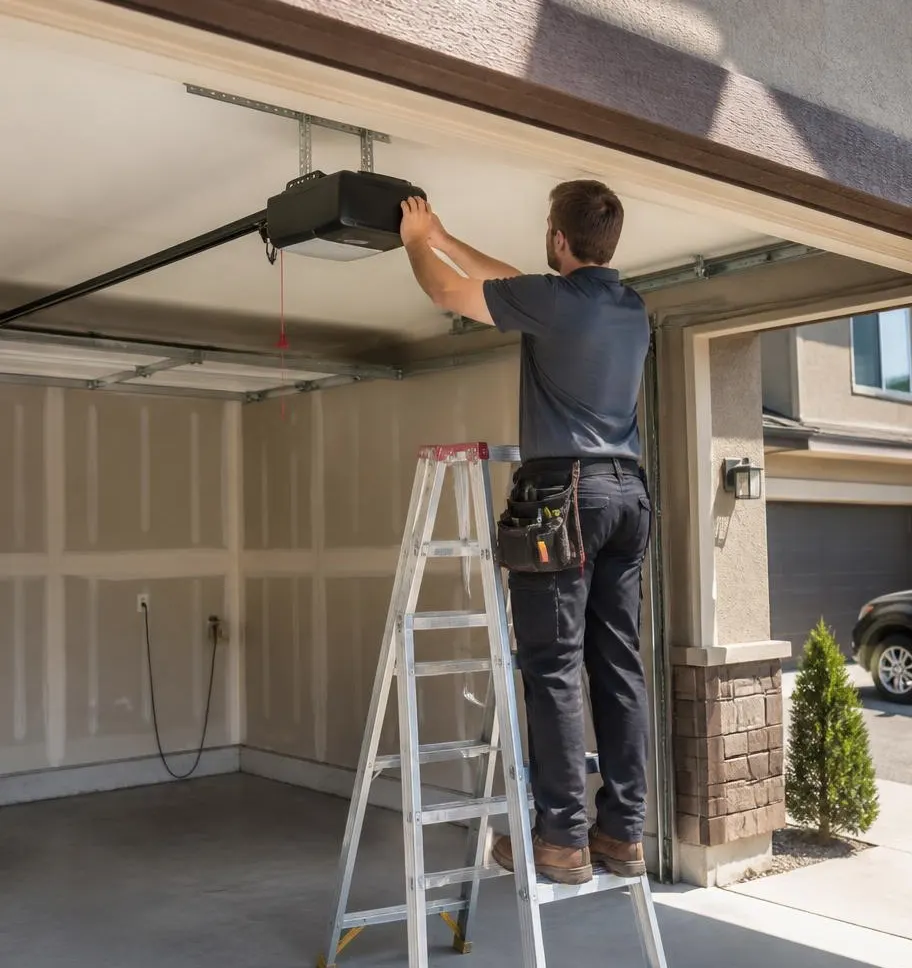
The short answer: the red emergency release cord disconnects your garage door from the automatic opener so you can move it by hand. Pull it when the power is out or the opener has failed and the door is fully closed. Do not pull it while the door is open, partway open, or if you suspect a broken spring — without the opener holding it, an unsupported door can drop suddenly and hard.
What the cord actually does
Every garage door opener connects to the door through a trolley that rides along a track. The emergency release cord, usually a red rope with a plastic handle, disconnects that trolley from the drive mechanism. Once disconnected, the door is no longer attached to the motor at all — it moves purely on its springs and whatever force you apply by hand. That's the whole trick, and it's also the whole risk: when the cord is pulled, nothing but the springs and your grip is keeping the door from moving.
When pulling it is the right call
- Power outage with the door closed. If you need to get a car out and the opener has no power, pull the cord, lift the door manually, and prop it open if you'll be going in and out more than once.
- Opener malfunction with the door closed. Grinding gears, a motor that hums but doesn't move the door, or a trolley that's jammed are all reasons to disconnect and operate manually until a technician looks at it.
- Testing the door's balance. With the door closed and disconnected, a well-balanced door should lift with moderate effort and stay roughly where you leave it partway up. This is a useful diagnostic before calling for service, not a daily habit.
When pulling it makes things worse
The danger isn't the cord itself — it's pulling it at the wrong moment.
- Door is open or partway open. The springs are doing active work holding the door up. Disconnect the trolley and that weight has nowhere to go but down, often fast enough to injure a hand, foot, or pet, and hard enough to bend tracks or crack panels on landing.
- A spring is broken or sounds off. A loud bang from the garage, a door that feels suddenly heavy, or visible gap in a coiled spring all mean the spring has already failed or is about to. With one spring gone, the door has no reliable support at all — pulling the cord can let it slam down uncontrolled.
- Right after an earthquake or ground shift. If your home has had seismic retrofit work, the garage door's attachment points and bracing are part of that system. After any noticeable shaking, check for visibly bent track or a door sitting crooked in its frame before disconnecting anything — a misaligned door can come off its track entirely once freed from the opener.
How to pull it safely when conditions are right
- Confirm the door is fully closed.
- Pull the cord straight down, not at an angle, to fully release the trolley.
- Lift the door by hand using both hands at the bottom handle, lifting with your legs.
- To reconnect, open the door fully by hand first, then pull the cord toward the opener (or follow your opener's reconnect instructions) so the trolley re-engages with the next automatic cycle.
A coastal-climate note
Salt air along the Monterey Peninsula is hard on exposed hardware, and the release cord's plastic handle and the trolley mechanism it connects to are no exception. Cords left to bake in summer sun or get damp through winter rain can become brittle or stiff. During fall maintenance, give the cord a gentle tug-test with the door closed to make sure it still releases smoothly — a cord that's frozen in place by corrosion won't help you during a storm-related outage when you actually need it.
When to call Carmel-By-The-Sea Garage Door
If pulling the cord reveals a door that's unbalanced, unusually heavy, or won't stay put when partway open, that's a spring problem, not a cord problem, and it's not a DIY fix — springs are under heavy tension and can cause serious injury. Our Spring Replacement service handles that safely, and our Garage Door Opener Services can diagnose why the opener failed in the first place, whether it's a wiring issue, a dying motor, or a trolley that's worn out from years of coastal humidity. If your door came off track after a release or a jolt, don't force it back — call us before you risk further damage.
If your release cord feels stuck, your door drops faster than it should, or you just want it checked before the rainy season brings more power blips, call Carmel-By-The-Sea Garage Door. We serve Carmel-By-The-Sea, Monterey, Pacific Grove, Pebble Beach, Carmel Valley, Seaside, Marina, and Del Rey Oaks, and we'll have a technician out to make sure your door works the way it should, every time you need it.